A Fever, a Guess, and a Prayer: What Visiting the Doctor Actually Looked Like Before Modern Medicine
A Fever, a Guess, and a Prayer: What Visiting the Doctor Actually Looked Like Before Modern Medicine
Imagine waking up with chest pain. Not crushing, not dramatic — just a persistent ache that won't go away after a few days. Today, you might pull up a telemedicine app before breakfast, describe your symptoms to a doctor on your phone screen, and be directed to a clinic for an EKG within the hour. Results arrive digitally. Your primary care physician can view them before lunch.
Now imagine the same scenario in 1965. You call your doctor's office, hope to get an appointment within the week, drive across town, describe your symptoms as best you can, and wait while the physician does what physicians did then: listen, press, tap, and think. If he suspected something serious, he might order a test. That test might take days to process. The results would come back on paper, filed in a manila folder, in a cabinet somewhere in the office. Nobody would follow up unless something was very wrong — and sometimes not even then.
The gap between those two experiences is enormous. And most of us have no idea how recently the modern version became normal.
The Art of Educated Guessing
For the better part of the 20th century, medicine was as much craft as science. Physicians were trained observers who relied heavily on physical examination, patient history, and clinical intuition. That wasn't incompetence — it was the state of the art. The tools simply didn't exist yet.
Blood work was available, but slow. X-rays could reveal broken bones and some lung conditions, but they offered a flat, limited picture of what was happening inside the body. Diagnosing something like a torn ligament, a herniated disc, or an early-stage tumor often came down to ruling things out over months of follow-up visits.
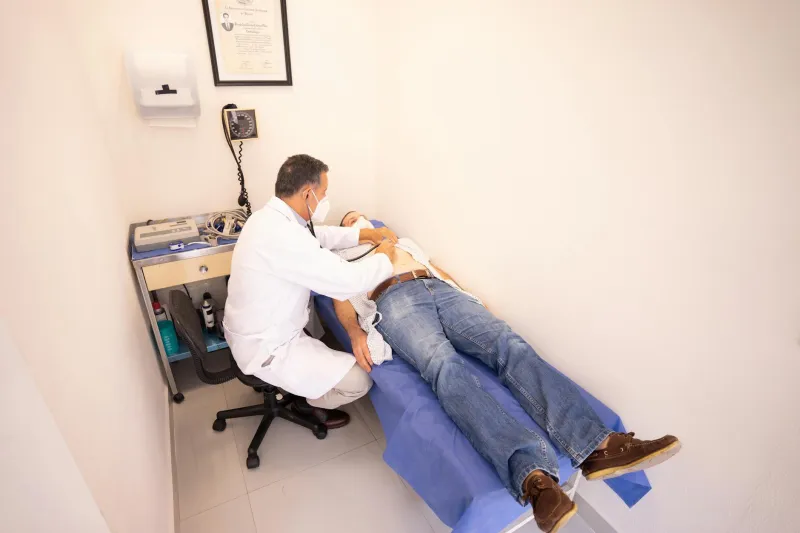
The stethoscope, invented in 1816, remained one of the most important diagnostic instruments well into the 1970s. Think about that. For over a century and a half, one of the most powerful things a doctor could do was press a small listening device to your chest and hear what your heart sounded like.
The MRI Wasn't Always There
The first MRI scan on a human being happened in 1977. The machines weren't widely available in American hospitals until the mid-1980s, and even then, access was limited and costs were staggering. A technology that today feels routine — that can detect tumors, map brain activity, and identify joint damage with extraordinary precision — is barely forty years old in practical clinical use.
CT scans entered hospitals in the early 1970s. Ultrasound became standard in obstetrics around the same time, though it took years to spread widely. Before these tools existed, a doctor trying to understand what was happening inside a patient's abdomen had limited options: physical examination, exploratory surgery, or waiting to see how symptoms developed.
Waiting, in fact, was a major feature of mid-century healthcare — not a flaw in the system, but the system itself. Watchful waiting was a legitimate medical strategy because there often wasn't much else available.
Your Medical Records Lived in a Filing Cabinet
Here's something easy to forget: electronic health records didn't become standard in the United States until the 2010s. The HITECH Act of 2009 included financial incentives for hospitals and providers to adopt digital record systems, and adoption accelerated sharply through the early part of that decade.
Before that, your medical history existed on paper. Possibly several sets of paper, across multiple offices, none of which could talk to each other. If you moved cities, changed doctors, or ended up in an emergency room far from home, the physician treating you started essentially from scratch. They asked questions, you answered as best you could, and everyone hoped your memory was accurate.
The idea that a doctor in Phoenix could instantly pull up test results ordered by a specialist in Boston — that's genuinely new. It's so new that many older patients still find it slightly surprising.
The Home Health Revolution
Home blood pressure monitors became commercially available in the 1970s, but they were bulky, expensive, and not widely used by ordinary households for years. The idea of regularly monitoring your own vitals at home — tracking resting heart rate, blood oxygen levels, sleep patterns, irregular heartbeat detection — would have sounded like science fiction to most Americans as recently as 1995.
Today, a $250 smartwatch does all of that passively, without you thinking about it. The Apple Watch received FDA clearance for ECG monitoring in 2018. Wearable glucose monitors are now available without a prescription. The patient who once had no way of knowing their blood pressure was dangerously elevated between annual checkups can now check it every morning before coffee.
Telemedicine, meanwhile, existed in limited forms for decades but exploded during the COVID-19 pandemic. By 2021, telehealth visits accounted for roughly 17% of all medical appointments in the US — a figure that would have been unimaginable in 2019.
What We Gained — and What We Still Get Wrong
None of this means modern medicine is perfect. Diagnostic errors still happen. Wait times for specialists in many parts of the country remain frustratingly long. The uneven distribution of healthcare access means that the high-tech version of medicine isn't equally available to everyone.
But the baseline has shifted in ways that are hard to overstate. The average American today has more real-time information about their own body than any physician in 1960 had access to in an entire clinical practice. Diseases that were once death sentences — certain cancers, HIV, hepatitis C — are now manageable or curable. Conditions that once required exploratory surgery to diagnose can be identified with a non-invasive scan in under an hour.
For most of human history, getting sick meant uncertainty, delay, and a lot of hoping for the best. The tools that changed that are recent enough that many Americans alive today remember a world without them. That's worth pausing on — the next time a test result appears in your patient portal before you've even made it home from the clinic.