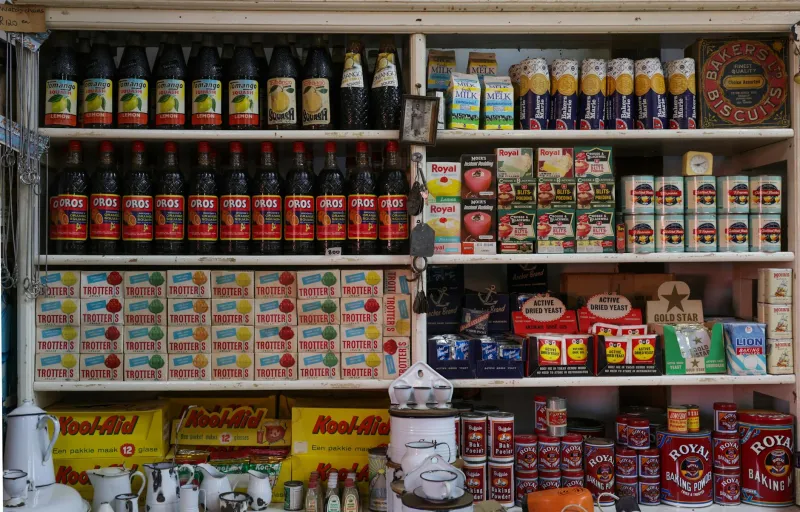
The Man Behind the Counter Who Knew Everything
Walk into Murphy's Corner Store in 1975, and Murphy himself would greet you by name before you reached the penny candy display. He knew your father bought Marlboros and your mother preferred Tide over Cheer. He remembered that your family always needed extra bread before big storms and that your grandmother visited every Tuesday for her arthritis medicine and a chat about the weather.
 Photo: Murphy's Corner Store, via easttaylorcreative.com
This wasn't customer service training or relationship management software—it was human commerce operating at the speed of memory and care. Murphy didn't need purchase history reports because he lived that history every day, watching families grow up through their shopping habits, tracking neighborhood rhythms through the ebb and flow of everyday needs.
The Credit System That Ran on Handshakes
Behind Murphy's register sat a small wooden box filled with index cards, each bearing a family's name and running tab. The Johnsons owed $12.50 for groceries from last week. The Kowalskis had paid down their account but still carried a balance from their daughter's birthday party supplies. Mrs. Chen always paid on Fridays when her husband got his paycheck.
This informal credit system required no background checks, credit scores, or digital verification. Murphy extended credit based on character, history, and gut feeling. He knew who struggled financially but always made good eventually, and who had steady income but sometimes forgot to settle up. The system worked because it was built on relationships that existed beyond single transactions.
When Shopping Was Social Architecture
The corner store functioned as neighborhood communication headquarters. Murphy knew whose teenager was looking for a summer job, which family was planning a move, and who might need extra help during difficult times. He connected people organically—mentioning to Mrs. Rodriguez that the Brennans were looking for a babysitter, or letting old Mr. Peterson know that the new family down the street seemed nice and had a son who liked baseball.
These connections happened naturally because Murphy saw the whole neighborhood's patterns. He noticed when the Hartley family stopped buying their usual groceries and quietly arranged for their bill to be covered by anonymous neighbors. He knew which kids walked home alone and made sure they felt safe stopping by for a snack and some adult conversation.
The Inventory That Reflected Real Life
Murphy didn't stock items based on corporate planograms or regional sales data—he stocked what his neighbors actually needed. He carried Mrs. O'Brien's special tea that she couldn't find anywhere else, and he kept extra school supplies in August because he knew which families couldn't afford back-to-school shopping all at once.
When the Johnson baby was born with allergies, Murphy started carrying specialty formula without being asked. When the high school started requiring graphing calculators, he ordered extras and let families pay in installments. His inventory decisions were made with specific faces and circumstances in mind, not abstract market segments.
The Death of Human-Scale Commerce
The corner store began disappearing in the 1980s, squeezed out by supermarkets that offered lower prices and wider selection. Families started driving to shopping centers where efficiency mattered more than relationships, where scanning barcodes replaced personal recognition, where customer loyalty programs tried to replicate what Murphy had provided naturally.
We gained convenience and lost continuity. The new stores knew our purchase history through digital tracking but couldn't remember our names or circumstances. They offered competitive prices but couldn't extend credit based on character. They provided one-stop shopping but eliminated the social connections that had made commerce feel like community.
What Algorithms Can't Replicate
Today's retail giants know more about our shopping patterns than Murphy ever could, but they know us as data points rather than human beings. Amazon's recommendation engine can predict what we might want to buy, but it can't offer comfort during family crises or celebrate our children's achievements. Self-checkout machines are faster than human cashiers but can't provide the local news update that Murphy offered with every transaction.
The personal touch that defined corner store commerce required physical presence, repeated interaction, and genuine investment in customer wellbeing. These qualities can't be scaled, automated, or optimized—they only exist in relationships between real people who see each other regularly and care about each other's lives.
The Social Cost of Efficiency
When we traded Murphy's store for Walmart's efficiency, we gained lower prices and lost social infrastructure. The corner store was where neighbors met accidentally, where community news traveled naturally, and where informal support systems operated quietly. It was retail therapy in the truest sense—not shopping as emotional outlet, but shopping as community connection.
Modern retail has eliminated friction from commerce but also eliminated the human moments that made shopping feel meaningful. We can buy anything we want instantly, but we've lost the experience of being known, remembered, and cared for by the people who serve us.
The Memory Palace We Abandoned
Murphy's mind was a living database of neighborhood life, updated continuously through daily interactions and maintained through genuine interest in his customers' wellbeing. He was part retailer, part social worker, part community historian—roles that no algorithm can combine effectively.
The corner store represented commerce at human scale, where business success depended on understanding people as complete individuals rather than purchasing behaviors. Murphy prospered because his neighbors prospered, and his success was measured in relationships maintained over decades, not quarterly profit reports.
We've built a retail system that knows everything about what we buy but nothing about who we are. The corner store knew everything about who we were and somehow that made what we bought feel less important than how we were treated. In our rush toward efficiency, we lost the radical idea that commerce could be an expression of community care rather than just economic transaction.