
And That's the Way It Was
"Good evening. This is the CBS Evening News with Walter Cronkite." For nineteen years, those words signaled the beginning of America's daily news ritual. But it was Cronkite's closing phrase that truly mattered: "And that's the way it is," followed by the date, followed by silence. Not just the end of a broadcast—the end of the news day itself.
In 1975, when Cronkite signed off at 7:00 PM Eastern, Americans understood they had received their complete daily briefing on world events. There would be no updates until tomorrow's newspaper arrived on the driveway, no breaking news alerts interrupting dinner, no late-night analysis shows dissecting every statement and gesture. The news was over. It was time to live your life.
This wasn't a limitation of technology—it was a conscious design choice that shaped how an entire generation understood information consumption. The news had a beginning, middle, and end. Like a well-constructed story, it provided closure.
The Ritual of Shared Knowing
Every weeknight at 6:30 PM, roughly 20 million Americans would gather around television sets for the same thirty-minute experience. Families planned dinner around the evening news. Restaurants noticed the dinner rush starting precisely at 7 PM. Phone calls were timed to avoid the sacred half-hour when America learned about its day.
The format was elegantly simple: international news, national politics, human interest stories, sports, and weather. Cronkite and his contemporaries at NBC and ABC presented events with authoritative finality. They didn't speculate about tomorrow's developments or analyze the political implications of every statement. They reported what happened, provided necessary context, and moved on.
This created a unique form of collective knowledge. When Cronkite announced that President Nixon would resign, or that American hostages had been taken in Iran, the entire country learned simultaneously. There was no social media echo chamber, no partisan analysis immediately following the facts, no opportunity to seek out confirming or contradicting sources. Americans absorbed the same information at the same time and then discussed it with neighbors, coworkers, and family members who had shared the identical experience.
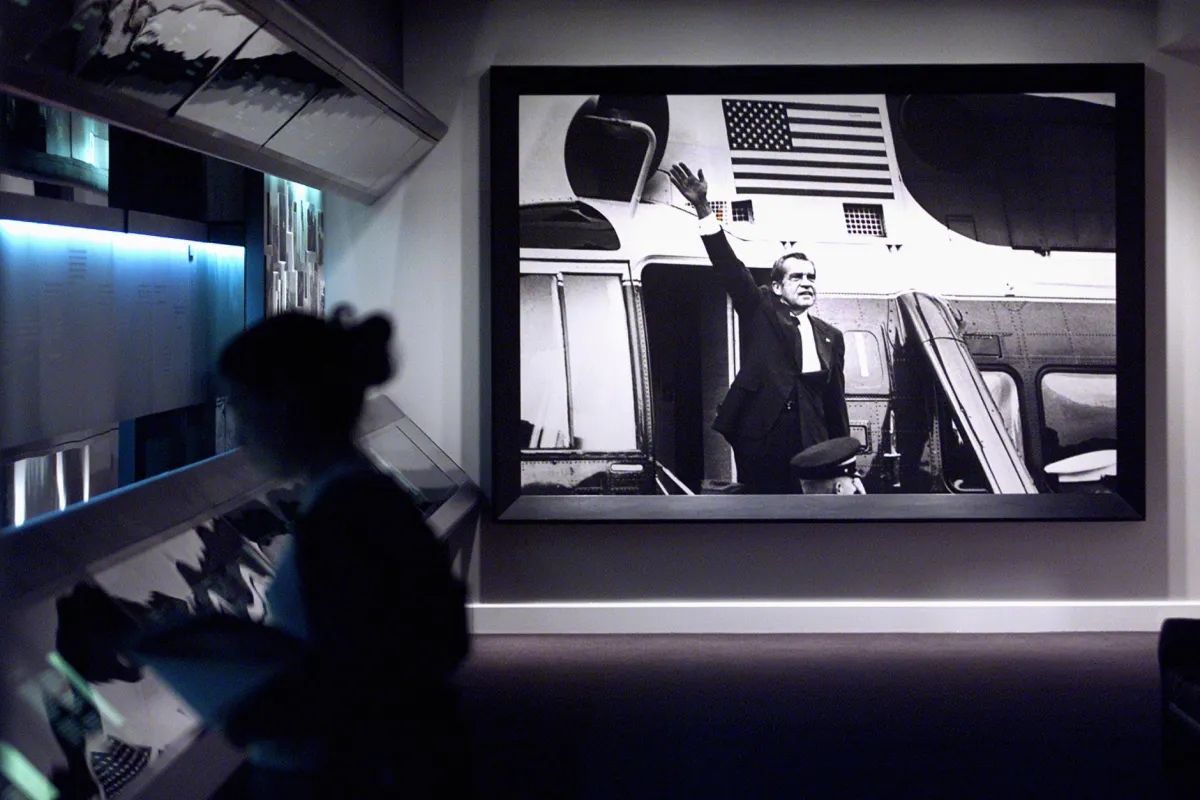 Photo: President Nixon, via wtop.com
The Psychology of Information Limits
The evening news format reflected a fundamentally different relationship with information. Americans in 1975 accepted that they couldn't know everything immediately. Major events might unfold over days or weeks before the complete story emerged. This created patience for complexity and tolerance for uncertainty that seems almost quaint today.
When the Iranian hostage crisis dominated headlines for 444 days, Americans received updates through the evening news and morning newspapers, but they weren't consuming minute-by-minute analysis or real-time social media commentary from every conceivable angle. They learned what they could learn, discussed it with people they actually knew, and then went about their daily lives.
This information diet had psychological benefits that researchers are only now beginning to understand. Limited news consumption reduced anxiety about events beyond personal control. The clear endpoint of each news day prevented the endless rumination that characterizes modern media consumption. Americans could feel informed without feeling overwhelmed.
When Breaking News Actually Broke Things
The term "breaking news" carried real weight in the Cronkite era because it happened so rarely. When CBS interrupted regular programming for special reports, viewers knew something genuinely significant was occurring. The assassination attempt on President Reagan, the Challenger disaster, or major international crises warranted breaking into scheduled programming because the news couldn't wait until evening.
 Photo: Space Shuttle Challenger, via www.nasa.gov
This scarcity gave breaking news tremendous impact. Families would call each other when special reports appeared, gathering around television sets for shared moments of national importance. The interruption of normal life felt proportional to the significance of events.
Today, "breaking news" appears on screen dozens of times daily, covering everything from weather updates to celebrity gossip to preliminary reports that often prove incorrect. The constant state of breaking news has paradoxically made it harder to identify truly significant events. When everything is urgent, nothing feels urgent.
The Cable Revolution Changes Everything
CNN launched in 1980 with a revolutionary premise: news twenty-four hours a day. Initially, this seemed like an obviously beneficial development. Why shouldn't Americans have access to information whenever they wanted it? Why should news be confined to arbitrary time slots when events happened continuously?
The early years of cable news maintained some boundaries. CNN repeated the same stories throughout the day, updating as new information became available. But the format gradually evolved to fill the endless time slots. Analysis replaced reporting. Opinion shows multiplied. The same stories were examined from multiple angles, dissected by panels of experts, and connected to broader political narratives.
By the 1990s, the evening news was competing with cable networks that provided continuous coverage of the same events. Cronkite's successors found themselves summarizing stories that viewers had already followed throughout the day on other channels. The role of the evening news as America's daily briefing gradually diminished.
The Internet Destroys the Last Boundaries
The rise of internet news in the 2000s eliminated the final constraints on information consumption. News websites updated continuously. Social media provided real-time commentary from millions of sources. Push notifications delivered breaking news alerts directly to personal devices, making it impossible to avoid updates even when actively trying to disconnect.
The modern news consumer faces choices that would have seemed overwhelming to Cronkite's audience. Hundreds of sources provide different versions of the same stories. Analysis begins before facts are fully established. Every development triggers immediate commentary, speculation, and political interpretation.
This abundance of information creates what researchers call "news fatigue"—the exhausting sense that there's always more to learn, more context to understand, more analysis to consider. The clear endpoint that Cronkite provided has been replaced by an endless stream of updates that never quite provides the satisfaction of being fully informed.
What We Lost in the Translation
The transformation of news consumption brought obvious benefits. Americans can now access information from multiple perspectives, fact-check claims in real-time, and stay informed about developing stories as they unfold. The diversity of sources has broken up the oligopoly of network news and given voice to previously marginalized perspectives.
But something valuable was lost in the process. The shared experience of simultaneous news consumption created a common foundation for democratic discourse. When Americans got their news from the same sources at the same time, political discussions began with shared facts, even if interpretations differed.
The clear boundaries of news consumption also protected mental health in ways we're only now recognizing. The ability to be fully informed within defined limits prevented the anxiety and information overload that characterizes modern media consumption. Americans could feel like responsible citizens without dedicating their entire attention to current events.
The Anchor We Lost
Walter Cronkite retired in 1981, just as the media landscape was beginning its fundamental transformation. His final sign-off—"And that's the way it is, Friday, March 6, 1981"—marked the end of more than just a distinguished career. It was the last time a single voice could credibly claim to provide America with a complete daily summary of world events.
Today's news anchors compete for attention in a fragmented media environment where no single source can claim comprehensive authority. They provide analysis, opinion, and perspective, but they can't offer what Cronkite provided: the reassurance that you've learned what you need to know and can now turn your attention to other aspects of life.
The phrase "And that's the way it is" has become a relic of a more confident era in American journalism—a time when the news had an ending, when being informed had limits, and when a trusted voice could tell an entire nation that it was okay to stop learning and start living. That particular form of closure has drifted away with so much else from the world we used to know, leaving us with an endless stream of information but no clear sense of when we've heard enough.