The Wooden Drawers That Held All Human Knowledge
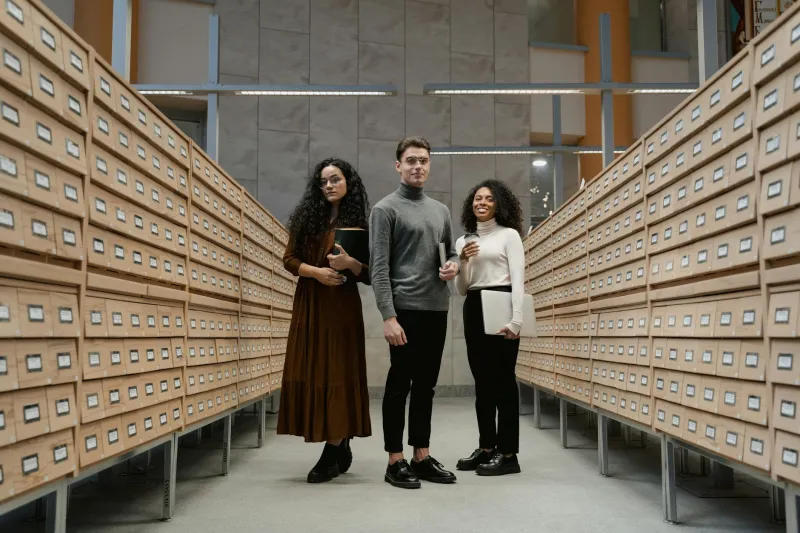
The card catalog at the Millbrook Public Library stood like a fortress of knowledge in the center of the main reading room. Forty-eight wooden drawers, each containing hundreds of yellowing index cards, organized according to a system that seemed both mysterious and logical to my ten-year-old mind. To find information about dinosaurs, you couldn't just type "T-Rex" and get instant results. You had to think like a librarian.
First, you'd try "Dinosaurs" in the subject catalog. Then maybe "Paleontology" if you knew that word. Sometimes you'd discover that what you really needed was filed under "Mesozoic Era" or "Extinct Animals." Each card led to potential discoveries, but finding the right card required patience, strategy, and a kind of intellectual detective work that modern Americans rarely experience.
This wasn't just a filing system—it was a thinking system. The card catalog taught an entire generation how to approach knowledge systematically, how to make connections between related topics, and how to persist through the frustration of not finding exactly what they wanted immediately.
The Art of Strategic Searching
Using a card catalog effectively required skills that went far beyond simple alphabetization. You had to understand how knowledge was categorized, how subjects related to each other, and how to think laterally when your first approach didn't work.
Say you wanted to write a school report about the Civil War. You couldn't just search for "Civil War facts" and get a neat summary. Instead, you'd start with the obvious: "Civil War, American." That would lead you to several books, but experienced researchers knew to dig deeper. You'd check "Lincoln, Abraham," "Slavery—United States," "Confederate States of America," and maybe "Reconstruction." Each card represented a potential pathway into your topic.
The real skill came in recognizing connections. While flipping through cards about Lincoln, you might notice references to "Emancipation Proclamation" or "Gettysburg Address." These discoveries led to new searches, which revealed new angles on your original topic. By the time you finished with the card catalog, you'd developed a sophisticated understanding of how your subject connected to broader historical themes.
This process took time—sometimes an hour just to identify the books you wanted to check out. But that time wasn't wasted. It was education in how knowledge is organized, how ideas connect, and how to think systematically about complex topics.
The Librarian as Knowledge Navigator
Behind every card catalog stood a librarian who understood the system's logic and could guide struggling researchers. These weren't just people who checked out books—they were professional knowledge navigators who'd spent years learning how information was classified and cross-referenced.
"What exactly are you looking for?" Mrs. Patterson would ask when she saw you standing helplessly in front of the card catalog. Her questions weren't just helpful—they were educational. She'd teach you to think more precisely about your information needs, to consider alternative approaches, and to understand how your topic might be categorized differently than you expected.
Librarians also served as quality filters. When you asked for books about space exploration, Mrs. Patterson knew which sources were authoritative, which were written for your grade level, and which offered the best illustrations or most current information. This human curation saved time and ensured that your research started with reliable sources.
The relationship between researcher and librarian created a different dynamic than today's solitary Google searches. You had to articulate what you were looking for, explain your assignment or interest, and often defend why you needed access to certain materials. This interaction forced you to think more clearly about your research goals and helped you develop communication skills around academic inquiry.
When Finding Information Required Real Skills
The card catalog system demanded intellectual abilities that we rarely exercise today. Cross-referencing required you to hold multiple concepts in your mind simultaneously and understand how they might relate. Following citation trails taught you to trace ideas back to their sources and forward to their implications.
Most importantly, the system required patience and persistence. You couldn't get frustrated and give up after thirty seconds of searching. Finding good information meant committing to the process, working through multiple approaches, and accepting that research was inherently time-consuming work.
This friction wasn't a bug in the system—it was a feature. The effort required to find information meant that you valued it more once you found it. The time invested in searching made you more likely to actually read and understand what you'd discovered. The process of navigating the catalog taught research skills that transferred to other areas of intellectual work.
The Algorithm That Thinks for You
Google's search algorithm represents one of humanity's greatest intellectual achievements. It can process billions of web pages in milliseconds, understand natural language queries, and deliver remarkably relevant results for almost any question you can imagine. The convenience is undeniable—what once took an hour in the library now takes thirty seconds on your phone.
But this convenience comes with hidden costs. Google's algorithm makes thousands of decisions about what you see and don't see, what gets prioritized and what gets buried. It predicts what you're looking for based on your search history, your location, and countless other data points. The result feels like magic, but it's actually a very sophisticated form of intellectual assistance that shapes how you think about information.
Modern search also eliminates the serendipity that made card catalog research so educational. When you're flipping through physical cards, you can't help but notice adjacent topics, related subjects, and unexpected connections. Google's laser focus on delivering exactly what you asked for means you miss the peripheral discoveries that often proved most valuable in traditional research.
What We Lost When We Stopped Getting Lost
The death of the card catalog represents more than just technological progress—it marks the end of a particular kind of intellectual development that shaped American thinking for generations. Learning to navigate physical information systems taught skills that extended far beyond library research.
Card catalog users developed better spatial reasoning, stronger memory skills, and more sophisticated understanding of how knowledge is organized. They learned to think hierarchically about information, to understand relationships between concepts, and to persist through intellectual challenges that couldn't be solved instantly.
Perhaps most importantly, the old system taught Americans to be comfortable with not knowing things immediately. The process of research was seen as valuable in itself, not just as an obstacle to overcome on the way to finding answers. This tolerance for intellectual uncertainty and willingness to work through complex problems gradually shaped how people approached learning throughout their lives.
The Instant Answer Culture
Today's students can access more information in five minutes than previous generations could find in weeks of library research. They can fact-check claims in real time, access primary sources from around the world, and collaborate on projects with peers thousands of miles away. These capabilities would seem miraculous to someone raised on card catalogs and microfiche readers.
Yet something crucial may be missing from this abundance. When information is instantly available, the skills required to find, evaluate, and synthesize it become less important. When algorithms predict what we're looking for, we lose practice in thinking through problems systematically. When answers come immediately, we may be less likely to sit with questions long enough to develop deeper understanding.
The card catalog era produced Americans who were comfortable with intellectual complexity, patient with research processes, and skilled at making connections between disparate pieces of information. These abilities didn't just make them better students—they made them better citizens, better problem-solvers, and better thinkers.
The next time you Google something and get an instant answer, remember that you're experiencing a kind of intellectual time travel. You're accessing information-finding capabilities that would seem supernatural to someone from the card catalog era. But also remember what that person might have possessed that you've never had the chance to develop: the deep satisfaction of earning your knowledge through patient, systematic exploration of the world's accumulated wisdom, one wooden drawer at a time.