Friday Night at the Food Court: When the Mall Was the Only Place You Needed to Be
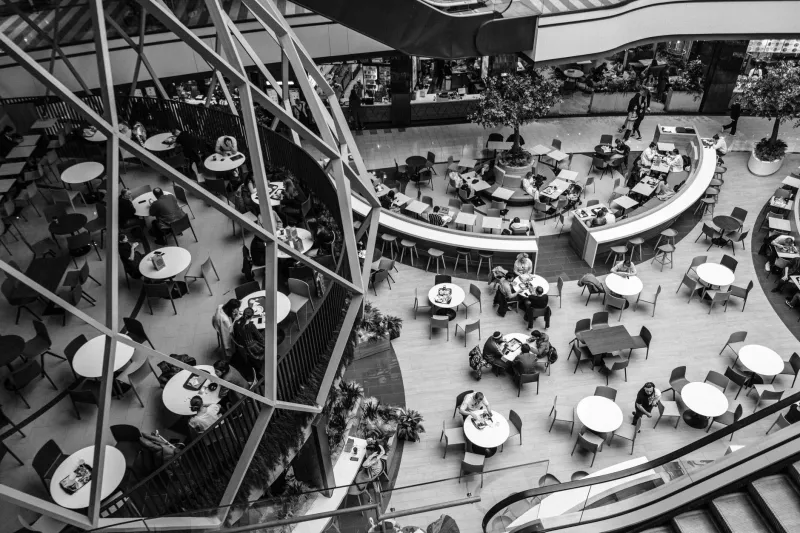
Somewhere around 1988, a fourteen-year-old in suburban Ohio is circling the mall for the third time. She's been here two hours. She's bought nothing. She's eaten a pretzel from Auntie Anne's and shared a Jamba Juice with her best friend, and she has no intention of leaving anytime soon. Her parents dropped her off at six. They'll be back at nine. In between, the mall is hers.
This was not unusual. This was just Friday.
The Mall as American Living Room
At their peak in the late 1980s and through most of the 1990s, shopping malls functioned as something that had no official name but everyone understood instinctively: a free, climate-controlled, socially rich public space that happened to also sell things. The shopping was almost beside the point.
For American teenagers especially, the mall solved a problem that suburban life had always struggled with — where do you go when you're too old to play in the yard and too young to drive anywhere interesting? The mall was the answer. It was safe enough for parents to accept, lively enough for kids to actually want to be there, and structured enough that you could spend three hours wandering without it feeling like you were doing nothing.
And it wasn't just teenagers. Families made evenings of it. Couples walked the corridors after dinner. Senior citizens did laps before the stores opened. The food court — that peculiar American invention — became a genuine gathering place, noisy and bright and full of the kind of low-stakes social energy that most communities had lost when the downtown drained away to the suburbs in the first place.
The Architecture of Hanging Out
What made the mall work as a social space wasn't accidental. The design was deliberate, even if the social outcome wasn't entirely planned. Anchor stores pulled traffic from opposite ends. The corridors between them created flow — a reason to walk, to pass the same spots repeatedly, to see and be seen. The food court anchored the center. Smaller specialty stores lined the route like chapters in a story you could wander through.
For teenagers, this layout was practically purpose-built for hanging out. You could browse without buying. You could sit on a bench near the fountain and watch people. You could drift in and out of Spencer Gifts or Sam Goody or the arcade at the far end of the east wing. You could run into people from school and pretend it was a coincidence. You could exist in public without any particular agenda, which is something that adolescence desperately requires and that most suburban environments fail to provide.
The stores understood this, even if they didn't always love it. Teenagers who weren't buying today were building brand familiarity and social associations that would shape purchasing habits for years. The mall let them in because their presence was part of the atmosphere. An empty mall felt dead. A mall full of teenagers on a Saturday night felt alive.
What Online Shopping Actually Replaced
When e-commerce began its long dismantling of American retail, the conversation focused almost entirely on economics — on the shift in purchasing behavior, on the collapse of anchor tenants, on the death of department stores. What got less attention was the social infrastructure that retail had quietly been providing.
Buying a shirt online is more convenient than driving to the mall. But it doesn't replace the two hours you spent walking around with your friends while incidentally deciding to buy a shirt. The transaction was never really the point. The point was the time, the space, the accidental sociality of being somewhere that other people also were.
Today's retail landscape — what remains of it — has tried to adapt by leaning into "experience." Malls that have survived have often done so by adding entertainment anchors: movie theaters, escape rooms, bowling alleys, restaurants with full bars. The logic is sound. But the experience they're selling is programmed and ticketed, which is a different thing entirely from the unstructured drift of a Friday night with nowhere specific to be.
The Thing Nobody Could Monetize
Here's the irony at the center of the mall's decline: the thing that made it genuinely valuable to American social life was the part that was always free. You didn't pay to walk the corridors. You didn't pay to sit at the food court. You didn't pay to run into someone you knew near the escalator and end up talking for forty-five minutes.
That unmonetized social space — the hanging-out-without-buying part — was never something the mall could sell, so when the economics shifted, there was no way to protect it. The stores left. The anchors closed. The corridors emptied. And what disappeared with them wasn't just a retail format. It was one of the last genuinely democratic public spaces in suburban America: a place where you didn't need money, a car, or a plan to have somewhere to be on a Friday night.
Some of those teenagers who circled the food court in 1988 are now in their late forties, watching their own kids scroll through TikTok in their bedrooms on a Saturday night. They know something is different. They're not always sure how to name it. But they remember the pretzel, and the fountain, and the strange, low-stakes pleasure of going somewhere just to be there.