One Movie, All Weekend: What We Lost When Everything Became Available Instantly
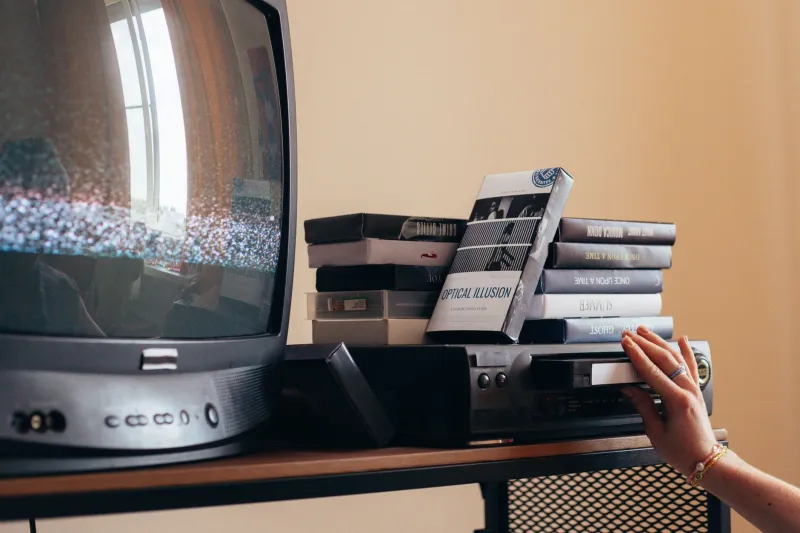
Sometime in the mid-1990s, a family in Indiana rents a movie on Friday evening. It's a two-hour drive round-trip to the video store — not really, but it feels that way. They picked carefully. They stood in the New Releases aisle for ten minutes, debating, because the wrong choice costs you the whole night. They bring it home, they watch it together, and then — because it's due back Sunday — they watch it again Saturday afternoon. By the time they return it, they know every line.
That movie, whatever it was, became part of them in a way that almost nothing does anymore.
The Economics of Scarcity
For most of American entertainment history, access was the constraint. You watched what was on. You went to the theater before the run ended. You rented what was available, not necessarily what you wanted. You waited a week — sometimes longer — to find out what happened next.
These weren't just inconveniences. They were, without anyone quite intending them to be, a set of conditions that shaped how deeply people engaged with what they watched. When you've waited seven days for a new episode of a show, you pay attention. When you've driven to the video store and made a deliberate choice, you're invested in that choice working out. When a movie is only in theaters for a few weeks, you make the effort to see it, and you take it seriously as an event.
Scarcity created intentionality. And intentionality created the conditions for genuine appreciation.
Must-See Was a Real Thing
The communal dimension of this is worth dwelling on. When NBC ran its Thursday night lineup in the 1990s — Friends, Seinfeld, ER — it wasn't just appointment television in the sense that people watched it. It was appointment television in the sense that not watching it put you at a social disadvantage. Monday morning at work or school, you needed to have seen it. The shared viewing was part of the experience.
That collective ritual — the show everyone watched at the same time, the episode everyone discussed the next day — required the constraint of broadcasting. Everyone watched Thursday night because that was the only time it was on. The limitation produced the community.
When streaming arrived and gave viewers the power to watch anything at any time, it also quietly dissolved that shared experience. You can watch a show now, or in three months, or never. Which means the social pressure to engage — the thing that pulled millions of people into the same story at the same moment — largely evaporated. Streaming is solitary by design, even when you're watching on the same couch.
The Paradox of Infinite Choice
Here's the thing about having access to everything: it turns out to be genuinely bad for the experience of enjoying any particular thing.
Psychologists have written about this for years under various headings — the paradox of choice, decision fatigue, the hedonic treadmill. The short version is that when options are unlimited, commitment becomes psychologically costly. You're always aware that something else exists. Abandoning what you're watching doesn't feel like a loss, because there's always another option waiting. So you quit things. You browse. You start three episodes of three different shows and finish none of them. You spend forty-five minutes choosing something and then fall asleep twenty minutes in.
The data on this is striking. Streaming platforms have found that a significant portion of users spend more time browsing than actually watching. The endless scroll — designed to keep you engaged — often produces a kind of paralysis instead. Everything is available, so nothing feels urgent, and without urgency, it's hard to care enough to commit.
What Finishing Something Used to Mean
There's a specific satisfaction in completing a piece of entertainment that feels increasingly rare. Not just reaching the end of something, but the sense of having genuinely inhabited it — having thought about it between viewings, having anticipated the next installment, having let it settle.
The family that watched the same rented VHS twice over a weekend wasn't doing that because they had no other option (well, they were, but stay with it). They were doing something that repetition makes possible: noticing details, catching things they missed, letting the story become familiar in the way that only familiarity allows. The movie became theirs in a way that a film you stream once and immediately forget cannot.
The theatrical experience worked similarly. You saw a movie at a specific time, in a specific place, with other people who had also made the effort to be there. The shared space and the shared attention created a kind of gravity that the living room — however good the TV — has never quite replicated. And when the movie left theaters, it was gone, which gave seeing it a weight that streaming can't reproduce.
The Drift Toward Abandonment
What the streaming era has normalized, almost without comment, is the abandonment of things. You stop watching a show after two episodes not because it's bad but because something shinier appeared in your feed. You start a film, check your phone, lose the thread, and close the app. You add things to your watchlist and never return to them. The watchlist itself becomes a kind of entertainment — the pleasure of accumulation without the commitment of engagement.
None of this is entirely the viewer's fault. The platforms are engineered to promote browsing, to surface new content, to keep you in the app rather than deepening your engagement with any single thing. The business model rewards time spent, not satisfaction achieved.
But something real was lost in the transition. The constraint of the old system — one rental, one broadcast window, one theatrical run — forced a kind of fidelity to the thing you'd chosen. You finished it because it was all you had. And in finishing it, you got something that infinite access quietly took away: the experience of actually being somewhere, in a story, long enough to let it matter.