The Layaway Line Was Long and Slow. That Was the Whole Point.
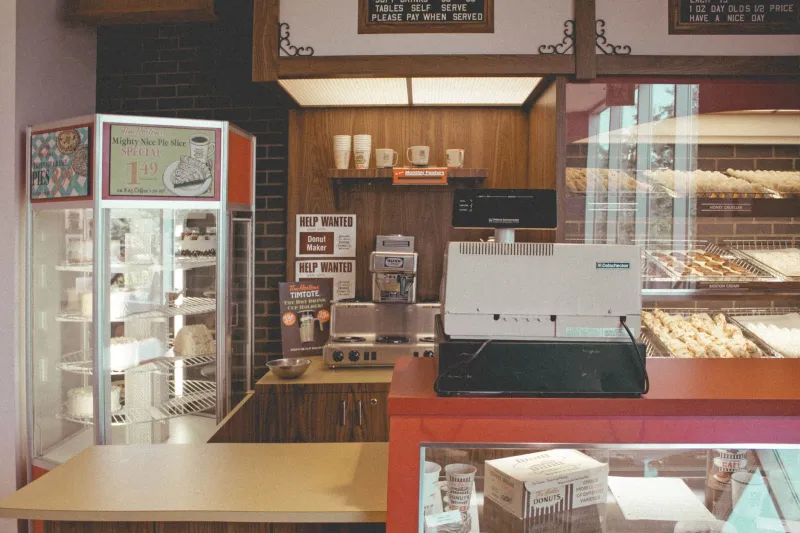
Picture a Kmart on a Saturday in November, 1987. The layaway counter is in the back of the store, past the housewares and the sporting goods. There's a line. There's always a line. A woman in a winter coat pulls a crumpled receipt from her purse and hands over thirty dollars in cash. The clerk finds her item in the storage room — a bicycle, a boom box, a doll in a pink box — checks it off, and files the receipt. The woman leaves without the thing she just paid for. She'll be back next week.
This was normal. This was, for a large portion of working-class America, how Christmas happened.
Layaway wasn't a financial product in the way we think about financial products today. It was a ritual. It had a cadence, a physical dimension, a built-in relationship between effort and reward that made the eventual payoff feel genuinely earned. And it's almost entirely gone now — replaced by one-click purchasing, instant financing, and a buy-now-pay-later industry that has preserved the debt while discarding every other element of the experience.
How It Actually Worked
The mechanics of layaway were simple almost to the point of being quaint. You selected an item, paid a small deposit — often as little as ten percent — and the store held it for you in a back room. You returned at regular intervals to make payments, and when the balance hit zero, you took the item home. No credit check. No interest. No approval process. If you couldn't make a payment, you made it up the following week. If you canceled, you got most of your money back.
For families without credit cards or reliable access to credit, this was enormously practical. But the practical dimension was almost secondary to the emotional one. The layaway counter was where you went when you wanted something badly enough to work for it slowly.
Department stores understood this. Sears, Kmart, Walmart, and dozens of regional chains built their holiday business models around it. In the weeks before Christmas, layaway departments were some of the busiest corners of American retail. The storage rooms behind those counters held thousands of items, each tagged with a name and a running balance — a physical record of other people's intentions and sacrifice.
The Weight of a Gift That Took Four Months
Ask anyone who grew up in a household that relied on layaway and they'll tell you the same thing: the gifts felt different. Not better in any objective sense. The bicycle wasn't faster because someone made twelve weekly payments on it. But the knowledge that it represented sustained effort — that a parent had stood in that line, week after week, in a coat that was too thin for the weather — gave it a weight that instant purchases simply don't carry.
This is not a sentimental observation. It's a fairly straightforward point about how humans assign meaning to things. Behavioral economists have documented something called the IKEA effect — the tendency to value objects more when we've invested effort in obtaining or assembling them. Layaway was, in a sense, effort built directly into the acquisition process. The waiting was part of the gift.
Children who received layaway gifts often knew, on some level, what they represented. They didn't always have words for it. But they understood that the thing under the tree had been held somewhere, in a back room with their family's name on it, while somebody worked to bring it home.
The Quiet Death of a Counter
Layaway began disappearing in the early 2000s as credit card adoption expanded and retailers decided the logistics — the storage space, the staffing, the returned merchandise — weren't worth the overhead. Walmart eliminated its year-round layaway program in 2006. Most other major chains followed. For a brief period, the practice staged a minor comeback during the 2008 recession, when suddenly a lot of Americans were rediscovering the appeal of spending money they actually had. But it never fully returned to its former place in American retail culture.
What replaced it was a spectrum of instant solutions. Credit cards, obviously. Then store financing. Then, most recently, buy-now-pay-later platforms like Afterpay and Klarna, which have become enormously popular — particularly among younger shoppers — by letting people take items home immediately and pay in installments over weeks or months. The payments are similar to layaway. The experience is almost exactly opposite.
With buy-now-pay-later, the item arrives before the sacrifice begins. There's no waiting, no weekly trip to the counter, no storage room with your name on a tag. The thing is already in your hands. The debt is abstract, deferred, managed by an app. The emotional transaction that layaway encoded — want something, work toward it, earn it — has been cleanly severed from the financial one.
What Instant Gratification Actually Costs
The consumer debt numbers tell part of the story. Americans are carrying more credit card debt than at any point in recorded history. Buy-now-pay-later delinquency rates have climbed steadily as the products have expanded. When the gap between wanting something and having it collapses to zero, the discipline that once lived in that gap tends to disappear with it.
But the more interesting cost is harder to quantify. It's the loss of a particular relationship with desire — the experience of wanting something for a sustained period, of working toward it incrementally, of the anticipation building week by week until the balance finally cleared. That experience shaped how people thought about money, about patience, about the connection between effort and reward.
The layaway counter wasn't just a payment system. It was, quietly, a way of teaching people that things worth having were worth waiting for. We replaced it with something faster. And in doing so, we got rid of the lesson along with the line.
The back rooms are empty now. The items are already on your doorstep. And something about the way we value what we own — and how quickly we stop valuing it — shifted when we stopped making the trip.