The Layaway Line Was Slow on Purpose: What We Lost When Waiting Became Optional
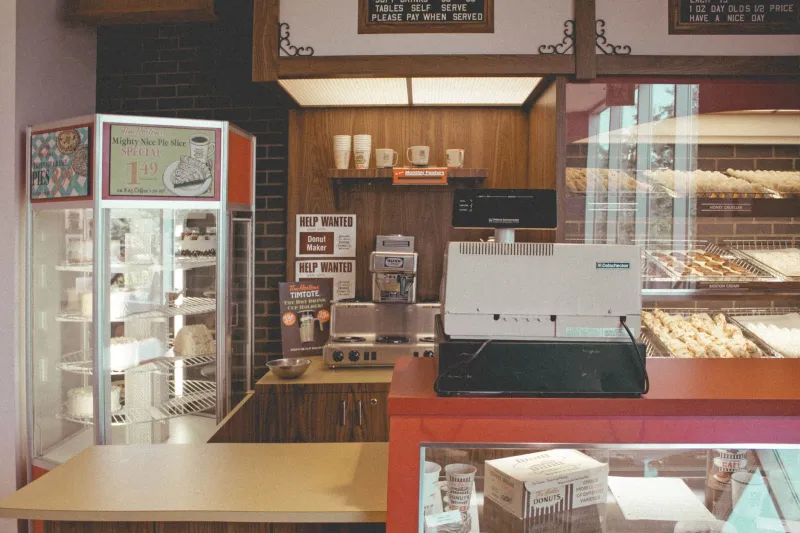
Somewhere near the back of every Kmart, past the automotive section and the garden center, there was a counter that doesn't exist anymore. It wasn't glamorous. Usually it was just a desk, a receipt book, and a storage room behind it full of boxes tagged with people's names. But that counter represented a financial philosophy that has almost completely vanished from American life — the idea that you should finish paying for something before you took it home.
Layaway was, for decades, how working-class families purchased things they couldn't afford all at once. A bicycle for Christmas. A new television. A winter coat. You'd pick the item out, put down a small deposit, and then return every week or two with whatever you could manage — ten dollars here, twenty there — until the balance hit zero. Then, and only then, did the item become yours.
The system sounds almost quaint now. It was.
The Ritual of the Counter
There was a specific texture to layaway that's worth reconstructing, because it's so far from how we shop today that it requires some imagination.
You started by choosing something you wanted but couldn't immediately afford. That choice involved real deliberation — you weren't going to go through the process for something you'd forget about in a month. Then came the deposit and the paperwork. Your item disappeared into the back room, tagged with your name, and you walked out of the store without it.
The weeks that followed involved a kind of low-grade anticipation that's genuinely hard to describe to anyone who grew up with one-click purchasing. You thought about the item. You looked forward to it. Every payment was a small act of commitment, a reminder that you'd decided this thing was worth working toward. By the time you finally picked it up, you'd already had a relationship with it.
For children watching parents use layaway, particularly around the holidays, this created a particular kind of suspense. You knew roughly what was coming, but you also knew it had to be earned — that it was the result of weeks of deliberate saving, not a moment's impulse.
What the System Was Actually Teaching
Layaway wasn't just a payment method. It was, without anyone calling it this, a financial education delivered in real time.
It taught that desire and acquisition were not the same thing. You could want something and then do the unglamorous work of actually affording it. It taught that value was connected to effort — that the bicycle meant more because you'd watched your parents pay for it in installments. It taught patience not as a virtue to be admired in the abstract, but as a practical skill with tangible rewards.
Perhaps most importantly, it taught that debt was something to be avoided. The whole architecture of layaway was designed around the opposite logic of credit: you paid first, you received later. The store held the risk, not you. If you couldn't keep up with payments, you got your money back (usually minus a small fee). You didn't get trapped.
The Credit Card Changed the Conversation
The decline of layaway tracks almost perfectly with the rise of consumer credit. By the 1980s, credit cards had become widely accessible to middle- and working-class Americans. The pitch was seductive and, on its surface, reasonable: why wait for something you could have right now?
The answer — that waiting was doing something useful — got lost in the transaction. Credit card debt climbed. Buy-now-pay-later apps extended the logic further, slicing purchases into frictionless installments that felt almost free in the moment. Amazon's one-click purchasing removed even the brief pause of entering payment information.
The cumulative effect was the elimination of the gap between wanting and having. And that gap, it turns out, was where a lot of important psychological work used to happen.
The Anticipation Economy
Researchers who study consumer behavior have documented something that probably won't surprise anyone who remembers layaway: anticipation is often more pleasurable than acquisition. The period of looking forward to something — imagining it, wanting it, working toward it — frequently generates more genuine happiness than the moment of receiving it.
Instant gratification short-circuits that process entirely. You want it, you buy it, you have it. The wanting and the having collapse into a single moment, and then it's over. The item arrives two days later and you've already half-forgotten you ordered it.
Layaway forced the wanting phase to stretch across weeks. That wasn't a design flaw. It was, in retrospect, one of the more psychologically sophisticated features of the system.
The Brief Return and What It Told Us
During the 2008 financial crisis, several major retailers quietly brought layaway back. Walmart and Kmart both reintroduced their programs as families found themselves squeezed between stagnant wages and rising prices. The programs were genuinely popular — which suggested the appetite for deliberate, debt-free purchasing hadn't entirely disappeared, just been buried under decades of easier alternatives.
Walmart eventually discontinued its layaway program for most items in 2021, citing the availability of buy-now-pay-later options. The logic was circular in a way that felt fitting: we don't need the old system because we have a new system that does the opposite of what the old one did.
Waiting as a Lost Skill
It would be easy to romanticize layaway and ignore that it was often used by families who had no other option — that it existed partly because credit wasn't available to everyone. The nostalgia deserves that caveat.
But there's something genuinely worth examining in what replaced it. Buy-now-pay-later apps carry interest rates that can dwarf traditional credit cards. Consumer debt in the United States sits at record highs. A generation raised on instant delivery and frictionless checkout has, by many measures, a complicated relationship with deferred gratification.
The layaway counter wasn't just a place to store Christmas presents. It was a physical reminder that wanting something and being ready for it were two different things — and that the distance between them was worth crossing slowly.