The Whole Block Was Watching: When Your Neighbors Raised You Too
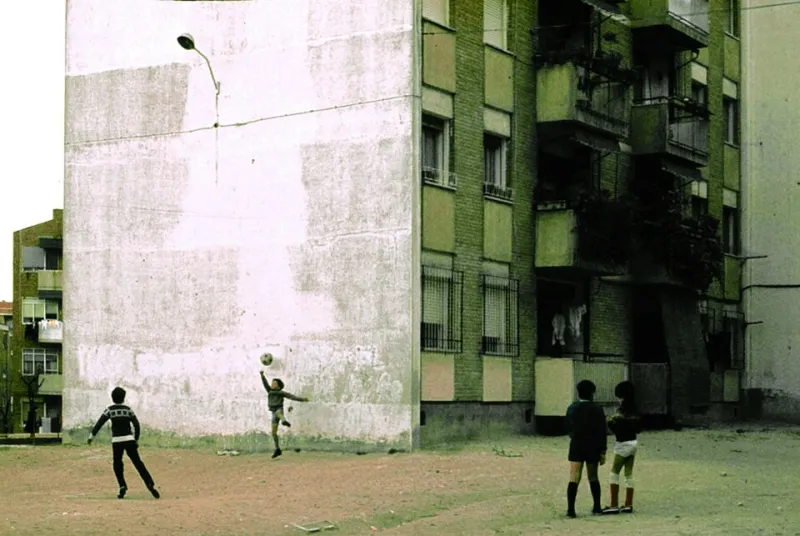
Photo: LBM1948, CC BY-SA 4.0, via Wikimedia Commons
Somewhere around 1975, a kid named Danny tried to sneak back onto Maple Street after dark. He made it about forty feet before Mrs. Kowalski opened her front door, arms crossed, and said, "Your mother is looking for you." Not a suggestion. Not a concern. A fact, delivered with the full weight of community authority behind it.
 Photo: Mrs. Kowalski, via theclimateconnector.co.uk
 Photo: Maple Street, via breakfastwithnick.com
Danny went home.
That moment — unremarkable at the time — represents something that has almost entirely vanished from American life: the neighborhood as a parenting partner. For most of the twentieth century, the rules a parent set inside the house extended far beyond the walls. They traveled down the block, through the park, into the corner store, and back again. Every adult in the vicinity was, in some informal but very real sense, on duty.
The Unwritten Contract Nobody Had to Sign
It worked because everyone understood the deal. You watched out for other people's kids, and other people watched out for yours. There was no formal agreement, no neighborhood association bylaw, no app to coordinate it. It was simply the way things worked — a cultural reflex built over generations of close-quarters living.
Bedtimes were part of this. When a parent said be in by dark, the whole block enforced it. Not because neighbors were nosy (though some certainly were), but because the community had a shared interest in keeping order. A kid out past curfew wasn't just that family's problem — it was a small disruption to the social fabric everyone had quietly agreed to maintain.
Relatives amplified the effect. Grandparents, aunts, uncles, and family friends created overlapping circles of accountability. A kid might dodge one adult, but the network was wide. Word traveled fast in a world where people actually talked to each other face to face, and the chance that your transgression would reach your parents before you did was genuinely high.
The Stranger Who Sent You Home
Here's the part that sounds almost unbelievable now: strangers participated too.
A store owner who recognized a local kid out too late would say something. A neighbor you'd never formally met would call out from a porch. Even a passing adult might stop and ask why you weren't home yet — and mean it as a genuine question, not a threat. The assumption was that children belonged to the community in some meaningful way, and that adults had a collective responsibility to shepherd them.
This wasn't universally gentle, and it certainly wasn't always fair. The same community enforcement that kept kids safe also enforced conformity in ways that weren't always kind. But the core mechanism — distributed parental authority — created a kind of low-level accountability that made individual household rules far more powerful than they would have been in isolation.
What Happened to the Network
The collapse came gradually, and from several directions at once.
Suburban sprawl replaced front porches with garage doors. Neighbors stopped knowing each other's names, let alone their children's bedtimes. Longer commutes meant parents were home later, kids were in structured after-school programs rather than roaming freely, and the casual street-level supervision that once happened naturally became logistically impossible.
Liability fears crept in too. The same culture that started putting warning labels on coffee cups made adults hesitant to correct someone else's child. What had once been a neighborly instinct started to feel like overreach — or worse, something that might invite a confrontation. The safest move became minding your own business, and slowly, everybody did.
Then screens arrived and rewrote the whole equation. The battle over bedtime stopped being about when do you come inside and became when do you put the phone down — a fight that happens behind closed doors, invisible to the community, with no backup from anyone.
The Isolated Household
Today's parents are fighting the bedtime war alone. There's no Mrs. Kowalski on the porch. There's no uncle who'll mention at Sunday dinner that he saw you out too late. There's no shopkeeper who knows your family. The burden of enforcement — once spread across an entire social ecosystem — now falls entirely on two adults (or sometimes one) trying to hold a line against devices engineered by billion-dollar companies to resist exactly that.
The parenting advice industry has tried to fill the gap. There are apps that lock screens, pediatric sleep guidelines, family contract templates you can download, and no shortage of books explaining why rest matters. All of it is useful. None of it is the same as a neighbor who just knows and acts accordingly.
What the Block Understood
The old system wasn't perfect. It was sometimes intrusive, occasionally unjust, and deeply dependent on the kind of homogeneous, stable communities that not everyone had access to. But it understood something that the modern model struggles to replicate: parenting is not a private act. Children exist in public space, and the norms that govern their behavior are most powerful when they're genuinely shared.
When Mrs. Kowalski sent Danny home, she wasn't overstepping. She was participating in something larger than herself — a quiet, ongoing agreement that the neighborhood had made without ever sitting down to make it.
That agreement is gone now. And the kids who would have benefited from it are navigating a world that's far more complicated, with parents who are more informed, more anxious, and more alone than any generation before them.
The bedtime still matters. The block just isn't watching anymore.