She Knew Every Kid by Name: The School Nurse Who Held American Public Health Together
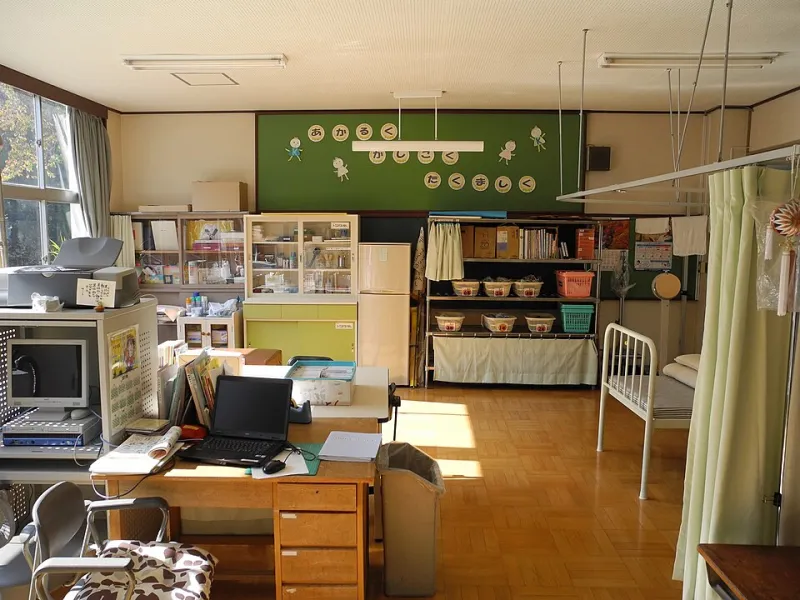
Photo: Douglas P. Perkins, CC BY 3.0, via Wikimedia Commons
If you went to a public school in America between roughly 1950 and 1990, you probably remember the nurse's office the way you remember the library — as a specific kind of room with a specific kind of smell and a specific adult who occupied it with a particular, reassuring permanence. The cot with the paper cover. The eye chart on the wall. The cabinet of supplies you weren't allowed to touch. And the nurse herself, who seemed to have been there forever and knew, without checking a file, that you'd had your tonsils out in third grade.
That figure — the full-time, building-based school nurse — was once a foundational piece of American public health infrastructure. Not glamorous. Not well-compensated. But genuinely important in ways that are only becoming clear now that she's largely gone.
What the Job Actually Involved
The school nurse did the visible things: she treated the scraped knees, administered the vision screenings, sent the feverish kids home. But the less visible work was arguably more significant.
Because she was present every day, in the same building, with the same students across multiple years, she accumulated something that no urgent care clinic or pediatric appointment could replicate: longitudinal knowledge. She knew which kids came in complaining of stomachaches every Monday morning and what that probably meant. She knew which child's asthma got worse in October. She noticed when a student who'd been healthy and energetic started showing up tired and withdrawn. She recognized patterns that only revealed themselves over time.
That kind of sustained attention was the job's real value. She wasn't just treating symptoms. She was watching, over years, for the emergence of something worth flagging — to a teacher, to a counselor, to a parent, to a doctor.
She also served as a translator between the medical system and families who didn't always know how to navigate it. A parent who couldn't get a straight answer about their child's recurring headaches might get a phone call from the school nurse who'd been keeping notes. A kid whose parents were uninsured or overwhelmed might have their vision problem identified in a routine screening that led, eventually, to glasses they'd never have gotten otherwise.
The Numbers Tell a Specific Story
The National Association of School Nurses has been tracking this for years, and the data is not encouraging. Fewer than half of American public schools have a full-time nurse on-site. In many districts, a single nurse covers two, three, or even four buildings — rotating through on a schedule that means any given school might have a nursing presence one or two days per week.
Some schools, particularly in lower-income districts, have no nurse at all. Health needs that arise on the wrong day get handled by a school secretary following a printed protocol, or by a teacher making a judgment call with no medical training.
The staffing gap didn't happen all at once. It accumulated over decades of budget pressures, competing priorities, and a gradual redefinition of what public schools were expected to provide. Nurses were rarely cut dramatically — they were simply not replaced when they retired, or had their hours reduced, or found their positions reclassified as part-time.
What the Gap Actually Costs
The consequences are harder to quantify than the staffing numbers, but they're real.
Children with chronic conditions — asthma, diabetes, severe allergies, epilepsy — are more medically complex to manage in school than they were a generation ago. The students who need daily medication administration, who need someone to recognize the early signs of a diabetic episode, who need an EpiPen administered without hesitation — these students are now, in many schools, depending on staff members who are doing their best but are not trained for medical emergencies.
Beyond the acute situations, the preventive and observational work simply doesn't happen when there's no one present to do it. The child whose hearing loss goes undetected because there was no one to run a screening. The student whose persistent fatigue turns out to be a thyroid problem that a nurse might have caught in a routine check. The kid who's being abused at home and whose bruises a nurse would have noticed and been legally and professionally equipped to report.
These aren't hypothetical losses. They're the predictable consequences of removing a trained observer from daily contact with children.
A Trusted Face in a Complicated System
There's also something less clinical worth naming. The school nurse occupied a specific emotional role in a child's experience of institutional life.
She was an adult who wasn't a teacher, wasn't an administrator, and had no stake in your grades or your behavior. Her job was simply to make sure you were okay. For a lot of kids — especially kids whose home lives were complicated, or who were anxious, or who needed a moment away from the social pressure of the classroom — the nurse's office was a safe place to land.
That's not a small thing. A trusted adult who knows your name, your history, and your family, and who operates from a posture of care rather than authority, is a resource that doesn't have an obvious replacement in the modern school environment.
The Drift Nobody Planned
No one made a deliberate decision to eliminate the school nurse as a public health resource. It happened the way a lot of important things disappear — through accumulation. Budget cuts here, a hiring freeze there, a gradual redefinition of what was essential and what was optional.
The result is a system where some of the most vulnerable children in America — the ones most likely to have unmet health needs, the ones whose families are least equipped to navigate the medical system independently — are also the ones least likely to have a trained health professional in their school building.
That's not a coincidence. It's a choice that was made slowly, without ever quite being acknowledged as a choice. And like a lot of things that drift away quietly, it's only fully visible once it's already gone.