Nobody Had Anywhere to Be: The Forgotten American Art of Just Waiting
Somewhere in America right now, a person is sitting in a doctor's waiting room, phone in hand, cycling through Instagram, a news app, a weather forecast for a city they're not visiting, and back to Instagram again. The wait is maybe fifteen minutes. It feels intolerable.
This would have been unrecognizable to their grandparents.
For most of the twentieth century, waiting wasn't a malfunction in the system. It was the system. Americans waited — in barbershop lines, at bus depots, in the hard plastic chairs of county offices — and they did it without a device to rescue them from the experience. They sat with their thoughts. They watched other people. They read a dog-eared copy of Life magazine from four months ago. They talked to strangers. And somehow, none of it felt like time being stolen from them.
The Waiting Room as Social Infrastructure
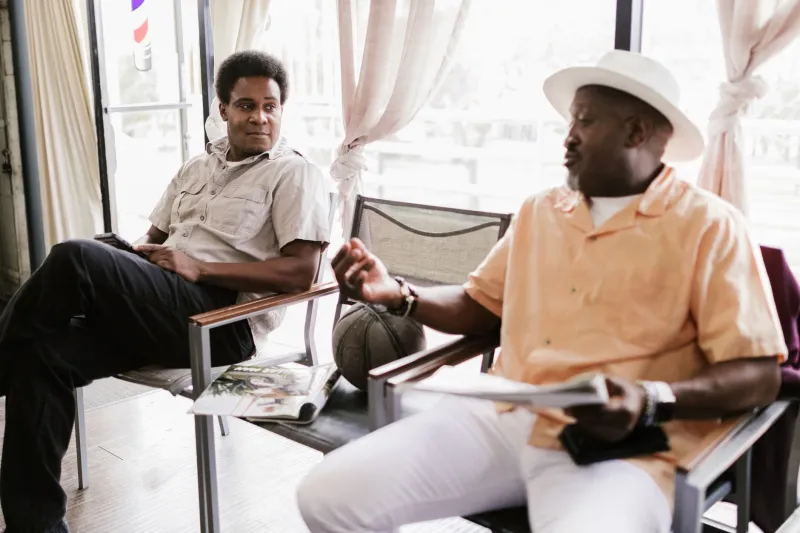
The mid-century American waiting room was its own kind of public square. Barbershops on Saturday mornings were as much a gathering place as a grooming destination. Men came in, took a number, and settled in for however long it took. Nobody was surprised if that meant an hour. The conversation that filled that hour — about the game, about the neighborhood, about nothing in particular — was the point as much as the haircut.
Bus stations told the same story. Before the interstate highway system made driving the default American mode of travel, Greyhound terminals in mid-sized cities were genuine crossroads. You'd sit next to a soldier heading home, a grandmother visiting her daughter in Cincinnati, a young man with everything he owned in one bag. You waited together. Sometimes you talked. Sometimes you just existed in the same space, which is its own kind of connection that we don't have a good word for anymore.
The DMV, the post office, the doctor's office — all of these were places where time moved differently, and Americans accepted that without much complaint. Not because they were more patient by nature, but because the culture hadn't yet decided that unoccupied time was a personal failure.
What a Two-Month-Old Magazine Actually Taught You
There's something specific worth saying about those waiting room magazines. A 1962 issue of Reader's Digest in a dentist's office in 1963 was not a news source. Everyone understood that. It was a different kind of reading — unhurried, serendipitous, with no algorithm deciding what you should find interesting. You picked it up because it was there. You read an article about the Alaskan coastline because it happened to be on the page you opened to. You learned something you hadn't planned to learn.
That randomness had real value. It's how people developed the vague, generalist curiosity that made them interesting at dinner parties and good at trivia and capable of talking to almost anyone. The waiting room was, in a quiet way, an education in the unexpected.
When Patience Was a Skill, Not a Virtue
The deeper shift isn't really about phones or apps. It's about what we decided waiting means. Somewhere in the last two decades, idle time stopped being neutral and became a problem. Every moment without input began to feel like a missed opportunity — for productivity, for connection, for self-improvement. The market responded accordingly. Podcasts for your commute. Audiobooks for your walk. A news feed for the thirty seconds you're standing in an elevator.
The result is a population that has quietly lost the ability to be bored without anxiety. Studies on attention and mental restoration have repeatedly found that unstructured time — time with no task, no input, no goal — is when the brain consolidates memory, processes emotion, and generates its most original thinking. The waiting room, for all its tedium, was doing something useful. We just couldn't see it.
Older Americans who grew up in that culture often describe a different relationship with their own minds. They were comfortable with silence in a way that feels almost foreign now. They could sit on a porch for an hour without reaching for anything. They didn't interpret stillness as emptiness.
The Quiet Disappearance of the Shared Wait
There's a social dimension to this that rarely gets mentioned. When everyone in a waiting room is staring at their own screen, the room stops being a shared experience. You're physically together but experientially alone. The chance encounter, the small conversation that goes somewhere unexpected, the moment of unexpected humor when someone says exactly what everyone else is thinking — all of that requires a certain baseline of mutual availability that smartphones have quietly eliminated.
The barbershop still exists, but the dynamic has shifted. Plenty of people now walk in with earbuds already in, a signal as clear as a closed door. The communal rhythm of waiting together, of being bored together, of passing time in the same general direction — that's harder to find.
What We Traded and What It Cost
None of this is an argument for going back. Waiting is legitimately less pleasant than not waiting, and the ability to be informed, entertained, or connected during downtime is a genuine convenience. The point isn't nostalgia for plastic chairs and outdated periodicals.
The point is that we made a trade we didn't fully think through. We got rid of boredom — or at least the experience of it — without fully accounting for what boredom was doing for us. The patience it built. The mental quiet it preserved. The low-stakes social encounters it made possible. The random articles about Alaska.
At some point, Americans stopped having time to kill and started treating every minute as something to be optimized. The waiting room didn't disappear. We just stopped actually being in it.
And something about the way we think, and the way we connect with strangers, and the way we sit with ourselves — drifted away while we were busy filling the silence.