When Five O'Clock Actually Meant Something: The Vanishing Line Between Work and Everything Else
Picture this: it's a Friday evening sometime in the mid-1980s. A manager at an insurance company in Columbus, Ohio closes a manila folder, slides it into a desk drawer, locks it, and walks out of the building. He gets in his car, drives home, and doesn't think about work again until Monday morning. Not because he's irresponsible. Not because he doesn't care. But because there is literally no mechanism by which work can reach him until he returns to the building where work lives.
He has dinner with his family. He watches the game. He sleeps.
This is not a fantasy. This was just Tuesday.
The Office Had Walls. That Was the Whole System.
For most of the twentieth century, the workplace had a physical address, and when you left it, you left work behind. The infrastructure of work — the files, the phones, the memos, the colleagues — existed inside a building, and when you walked out the door, you stepped outside the system. There was no way to be reached after hours unless you had a home phone number, and calling someone at home in the evening for non-emergency work matters was considered genuinely rude. You just didn't do it.
This wasn't a cultural accident. It was structural. Work stayed at work because work's tools were at work. The typewriter didn't follow you home. The filing cabinet didn't fit in your pocket. The internal phone system didn't have a roaming option.
The result was a hard, clear boundary that nobody had to negotiate or defend. When you clocked out, you were done. The evening belonged to you — or to your family, your community, your hobbies, your rest. Nobody called it "work-life balance" because balance wasn't a concept that needed a name. It was simply how time was organized.
The Slow Erosion Nobody Voted For
The shift didn't happen overnight, and it didn't happen all at once. It crept in.
The fax machine in the late 1970s and '80s was an early warning sign — suddenly documents could travel without a courier, and the office could reach you a little faster than before. Then came the pager, beloved by doctors and drug dealers alike, which introduced the idea that you could be summoned from anywhere. Then the BlackBerry, which gave executives the ability to send and receive email from their coat pockets, and which many of them genuinely believed was a gift.
By the time the smartphone arrived and email became something everyone carried everywhere, the transformation was essentially complete. The office had no walls anymore. Work had become a condition rather than a location, and the expectation of availability had quietly become permanent.
Nobody held a meeting to decide this. Nobody voted on whether the evening should belong to employers or employees. It just happened, technology enabling it and culture ratifying it, until "always on" became the default and anything less started to look like a lack of commitment.
What the Always-On Life Actually Costs
The mental health implications have been well-documented at this point, even if they're still not well-addressed. Chronic overwork is associated with elevated cortisol levels, disrupted sleep, increased anxiety, and a higher risk of cardiovascular problems. A 2021 study from the World Health Organization found that working 55 or more hours per week was linked to significantly higher rates of stroke and heart disease. The boundary between work and rest isn't just a lifestyle preference — it's a biological necessity.
But the costs go beyond individual health. Consider what the after-work hours used to contain. Dinner that lasted long enough to actually involve conversation. Kids who had a parent present, not physically in the room but mentally elsewhere. Hobbies that existed for their own sake, not as productivity exercises or networking opportunities. Friendships that didn't require scheduling three weeks in advance because evenings were genuinely open.
The slow colonization of personal time by work hasn't just made people more stressed. It's changed who people are outside the office — or rather, it's made it harder for people to be anyone outside the office at all. When work is always accessible, it becomes the dominant identity by default. Everything else fits around it.
The Pandemic Proved the Point, Then Made It Worse
Remote work was supposed to offer flexibility. For many people, what it delivered was the office in the bedroom, available at all hours, with no commute to serve as a buffer between professional and personal. Without the physical act of leaving a building, the psychological act of leaving work became something people had to invent for themselves — and many never managed it.
Some workers thrived. But surveys consistently showed that remote workers logged more hours than their in-office counterparts, responded to messages later into the evening, and reported higher rates of burnout. The flexibility was real, but so was the blurring. When your kitchen table is also your conference room, every room in your home carries a little bit of the office.
A growing number of companies are now experimenting with clearer boundaries — no-email-after-hours policies, mandatory vacation minimums, explicit guidelines about weekend communication. Several European countries have gone further, enshrining the "right to disconnect" in law. France, Belgium, Portugal, and others have created legal frameworks protecting workers from after-hours contact. The United States has not, and shows little sign of moving in that direction.
The Clock on the Wall Still Ticks
Somewhere in the drift from bounded workdays to permanent availability, something genuinely valuable got lost. Not productivity — American workers are, by most measures, more productive than ever. What got lost was the evening itself. The clear, protected stretch of time that belonged to you, to spend as you chose, without a notification pulling you back toward the desk.
The manager in Columbus with the locked filing cabinet and the quiet Friday night wasn't living in a golden age — workplaces then had their own serious problems. But he had something that's become surprisingly hard to hold onto: a life that work hadn't entirely colonized.
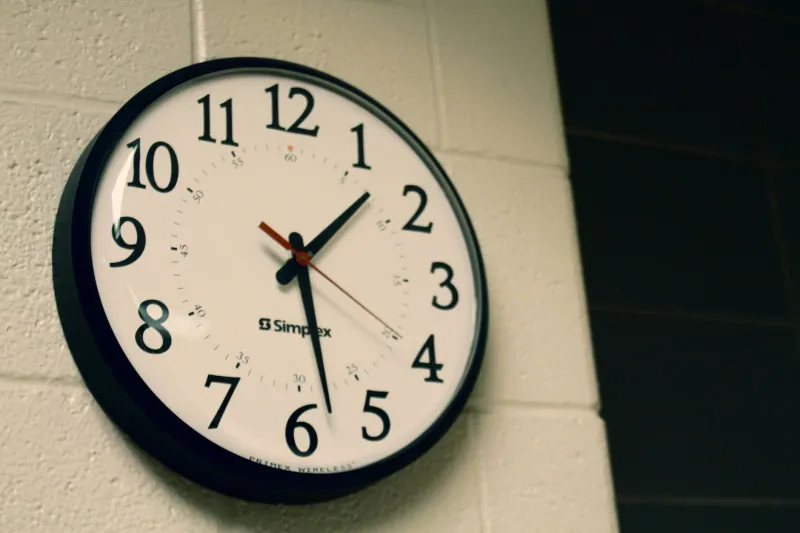
Five o'clock used to be a finish line. Now it's just a number on the clock.